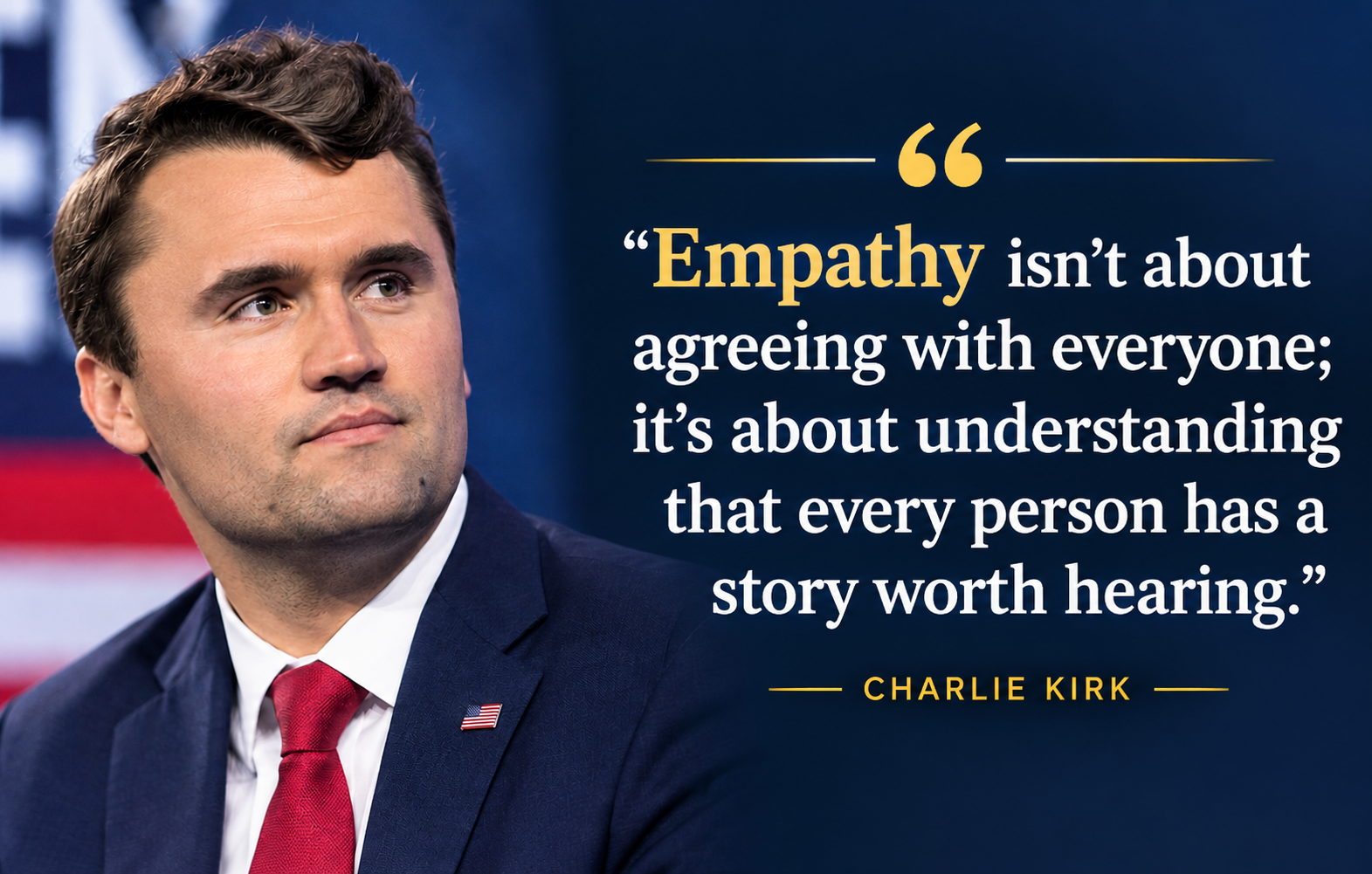
Charlie Kirk, the late conservative activist and co-founder of Turning Point USA, was known for his provocative statements on a wide range of topics. Among his most discussed and debated remarks were those concerning empathy. Kirk made it clear that he did not favor the word or the concept, arguing that it was a “made-up, new-age term” that did more harm than good. His preference for sympathy over empathy sparked widespread conversation about the nature of compassion, political rhetoric, and human connection. This article explores his quotes on the subject through ten thematic sections.
The Core Rejection of Empathy
-
“I can’t stand the word empathy, actually.”
-
“I think empathy is a made-up, new-age term, and it does a lot of damage.”
-
“Empathy is a made-up, new-age term that does a lot of damage.”
-
“I think empathy is a made-up, New Age term that – it does a lot of damage.”
-
“I can’t stand the word empathy. I think it is a made-up, new-age term.”
-
“I think empathy is a made-up, new age term that does a lot of damage.”
-
“I can’t stand the word empathy, actually. I think empathy is a made-up, new-age term that does a lot of damage.”
-
“I think empathy is a made-up, new age term that does a lot of damage.”
-
“I can’t stand the word empathy, actually. I think empathy is a made-up, New Age term that it does a lot of damage.”
-
“I can’t stand the word empathy.”
Sympathy Over Empathy
-
“Sympathy I prefer more than empathy.”
-
“I prefer sympathy. Sympathy is a much better word.”
-
“Sympathy is saying, ‘I’m sorry for what you’re going through, I’m going to try to help you.'”
-
“Empathy is like, ‘I’m going to become you, I’m going to feel exactly what you’re feeling.'”
-
“It’s impossible, it’s narcissistic, and it’s destructive.”
-
“Sympathy is not imbibing the same pain of one person but feeling sorry for one’s suffering.”
-
“Sympathy maintains a healthy, honest boundary.”
-
“It does not pretend to inhabit the other person’s consciousness.”
-
“Sympathy acknowledges another person’s suffering from a distance.”
-
“I prefer sympathy.”
Empathy as a Political Weapon
-
“It is very effective when it comes to politics.”
-
“When Bill Clinton said, ‘I feel your pain,’ that was a brilliant political move.”
-
“It was total nonsense, but it worked.”
-
“Empathy instead of sympathy completely shifted the conversation.”
-
“The debate became about who was a good person and who was a monster.”
-
“He labeled it ‘the No. 1 psychological trick of the left.'”
-
“A dastardly plot to prey on the emotions of conservatives.”
-
“When a political movement frames its platform entirely around empathy, it shifts the debate from the realm of efficacy to the realm of morality.”
-
“Kirk argued that this was a rhetorical trick.”
-
“Empathy works well in politics.”
The Impossibility of True Empathy
-
“It’s impossible to literally absorb and replicate another person’s pain within oneself.”
-
“It was impossible to truly feel another person’s unique suffering.”
-
“This was a ‘new-age’ delusion.”
-
“Pretending to do so often shifted the focus onto the observer’s own emotional state.”
-
“Rendering it inherently self-centered.”
-
“Empathy, to Kirk, meant trying to feel someone else’s pain or sorrow as if it were your own.”
-
“He argued that this was impossible.”
-
“The word ’empathy’ works well in politics though.”
-
“It’s narcissistic.”
-
“It’s destructive.”
Empathy Directed at the “Right” People
-
“The soldiers discharged for the jab, the children mutilated by Big Medicine.”
-
“Or the lives devastated by fentanyl pouring over the border.”
-
“Spare me your fake outrage, your fake science and your fake moral superiority.”
-
“Empathy, according to Kirk, ought to have limits.”
-
“It should be directed to those being ‘mutilated’ by vaccines.”
-
“And ‘devastated’ by fentanyl.”
-
“What troubled Kirk about empathy was its fixation on people ‘out there.'”
-
“Instead of those who should be the focus of Americans’ concern.”
-
“Empathy ought to have limits.”
-
“It should be directed to specific groups.”
The Selective Nature of Empathy
-
“Empathy is not toxic, but it is selective.”
-
“The grief that attended Kirk’s murder was not solely poured out by the political right.”
-
“Kirk would likely be surprised by this display of empathy by his opponents.”
-
“And perhaps a bit put off.”
-
“His legacy is the beneficiary of empathy.”
-
“But he couldn’t stand the term.”
-
“Empathy flows more easily to those who nurtured it in life.”
-
“When someone devotes their life to compassion, we mourn.”
-
“When someone devotes their life to hatred, the well of sorrow runs dry.”
-
“To decline to manufacture empathy for a man who abhorred is not apathy, but coherence.”
Empathy and the Culture of Violence
-
“Kirk thrived on talk of enemies, traitors, grooming, invasion, decline and replacement.”
-
“This is what happens when a culture soaks itself in the language of violence.”
-
“He specialized in stripping others of their sense of self.”
-
“What he sold to his loyalists was the permission to feel that cruelty was righteous.”
-
“The deeper irony is that Kirk was undone not just by one bullet.”
-
“But by the political culture he helped fertilise.”
-
“In the wake of his death, the air is thick with calls for empathy.”
-
“Politicians who eagerly shared his podium now urge decency, restraint and a pause.”
-
“Is sorrow for Kirk a moral obligation, or merely the performance of one?”
-
“Empathy, like compassion, has limits.”
Defending Kirk’s Position on Empathy
-
“This was likely as much a misquote as it is a quote out of context.”
-
“He was not expressing indifference to the plight of others.”
-
“Kirk was not rejecting kindness or understanding.”
-
“He criticized the misuse of ’empathy’ as a political weapon.”
-
“He was making a distinction between two very similar terms.”
-
“His very next words were, ‘I prefer sympathy.'”
-
“He was not at all opposed to feeling for the injured and suffering.”
-
“You can find Kirk saying he didn’t like this particular term.”
-
“But wasn’t at all opposed to feeling for the injured and suffering.”
-
“Painting Kirk as unworthy of empathy because of political disagreements is extremely wrong.”
Empathy and Human Connection
-
“When people stop talking, really bad stuff starts.”
-
“When marriages stop talking, divorce happens.”
-
“When civilizations stop talking, civil war ensues.”
-
“When you stop having a human connection with someone you disagree with.”
-
“It becomes a lot easier to want to commit violence against that group.”
-
“What we as a culture have to get back to.”
-
“Is being able to have reasonable disagreement.”
-
“Where violence is not an option.”
-
“It maintained a healthy, honest boundary.”
-
“Sympathy is saying, ‘I’m sorry for what you’re going through.'”
The Legacy of Empathy Controversy
-
“Kirk’s past comment on empathy resurfaced after UVU shooting.”
-
“His assassination has split the internet over how much empathy he ever deserved.”
-
“The internet wrestled with the problem of whether one ought to feel empathy for a man who disdained the very idea of empathy.”
-
“Perhaps nothing encapsulates Kirk’s worldview more than his take on mass shootings.”
-
“He spent his career insisting that gun deaths were a necessary price of liberty.”
-
“It’s worth it, he declared, to have the cost of unfortunately some gun deaths every single year.”
-
“So that we can have the Second Amendment to protect our other God-given rights.”
-
“Kirk’s genius, if you can call it that, was in knowing that cruelty makes better content than civility.”
-
“That sense of disdain ran through all his work.”
-
“The catalogue of ugliness is long, but the themes of delegitimisation, dehumanisation, and division were consistent.”
For More Beautiful Travel Blessings